(wrote this piece for the Times of India – in the process developing a renewed appreciation for some aspects of Manoj Kumar’s cinema, notably his use of music and staging of song sequences. More on that some other time)
------------------- Even for big fans of mainstream Hindi cinema, Manoj Kumar’s Roti Kapada aur Makaan can seem a strangely under-the-radar film today. “Strangely” because it was a huge hit fifty years ago – the biggest of 1974. It had an A-list cast, including, in one of his most striking supporting roles, Amitabh Bachchan, who was already well into his long-hair-and-sideburns phase. (This was after Zanjeer had pushed Bachchan to stardom, but before the superstardom that would come in the next two or three years.) There are some memorable songs, memorably visualised – and there is even a second-half subplot featuring the protagonist Bharat (inevitably played by Manoj Kumar himself) and his policeman brother, which anticipates the siblings-on-opposite-sides-of-the-law plot made iconic by Deewaar a year later.
And above all (to deploy the cheesy opening credit that the film uses for Shashi Kapoor), RKM was an unabashedly patriotic, sentimental film made during a specific moment in the nation’s history. A time when rising unemployment for even well-educated youth, and the perceived ineffectualness of college degrees, had created much frustration – adding a bitter taste to the late 1960s election slogan of “roti kapada aur makaan”.
Other political films about disaffected youngsters had been made in the previous few years, such as Gulzar’s Mere Apne, pointed and sardonic, and with a hard-edged ending. But Manoj Kumar’s lens was different, and this is what he was saying in his trademark style, combining an initially dark tone with an eventually upbeat one: things may be wrong with this country, but if we maintain our personal integrity, and trust in the democratic process, the tide will turn. There is despair in the film’s set-up – the key characters go through major trials – but there is also a clear sense that the story is arcing towards the light at the tunnel’s end. The early scenes gradually reveal the roti, kapada and makaan motifs and how these necessities can, in the wrong hands, become a trinity of demons, used to suppress underprivileged people: three of the villains are traders who use their monopoly to exploit the poor Tulsi (Moushumi Chatterjee) and others. “They tell us to get the slums picked up and shifted,” laments a man whose house is to be demolished, “but they never tell us where they should be shifted to.” (The scene is a reminder of a lyric from the 1953 black satire Mr Sampat – “Narakh mein bhi jagah nahin” – where poor people worry there won’t be enough space for them even in hell.) There are efforts to divide the country: hoarding goods to create shortages, setting a University on fire after radicalising students. The circle of poverty and misfortune is depicted in an exchange between Bharat and his girlfriend Sheetal (Zeenat Aman): “When will things change?” “When I get a job.” “When will you get a job?” “When things change.”
 Notwithstanding all this despair, there is an almost touching faith in the nation’s structural integrity and in the idea that our elected leaders will (with perhaps a few missteps here or there) do right by us. In one scene, as the villainous Madan Puri and his henchmen take a short break from their underground activities, Indira Gandhi’s August 15 speech denouncing black-marketing and hoarding can be heard on the radio; meanwhile Bharat, who had temporarily fallen in with the wrong people, penitently gazes at an Indira photo on the wall. With all the talk today about films that peddle only the government’s agenda, it is possible to wonder – especially given that the Emergency was announced only a few months later – if RKM is a little too respectful of sarkar.
The lens seems to be a sincere one, though. In terms of his age and career peak, Manoj Kumar occupies a middle ground between the Nehruvian idealism of Raj Kapoor and the disillusionment expressed by filmmakers of the Kundan Shah-Saeed Mirza generation in the 1980s. But Kumar’s overall hopefulness – and his almost childlike faith in certain ideals – is closer to the Raj Kapoor tone. This may be a reason why he is so unfashionable, or easy to parody, today. His conservatism, his hankering on old-world values and tradition-vs-modernity stereotypes, can seem laughable from the vantage point of today’s woke expectations that cinema should be progressive in a clearly observed way. There is also an understandable unease, given the jingoistic times we live in, about the hyper-nationalism that tells us that India was the birth of civilisation (as the lyrics of a famous song in Kumar’s earlier Purab aur Paschim have it).  But as is often the case with mainstream cinema, one must pay close attention to a film to see the many conflicting energies in it. In RKM, the self-righteous Bharat may be the central figure around whom the others pivot, the glue for the forging of various relationships (“Inn rasmon ko, inn kasmon ko, inn rishte naaton ko…” as the song “Main na Bhooloonga” has it) – but all the characters represent various aspects and possibilities (or futures) of India. Bharat’s brother Vijay (Bachchan) nearly turns to crime, but redeems himself by joining the army and serves the country in the most dramatic way possible. Their other brother Deepak (Dheeraj Kumar) performs a similar role a little less dramatically, as a policeman. Shashi Kapoor’s Mohan is a businessman who recognises his privileges and pays his taxes even if it means eliminating profits. (Could this be a viable future for a nation that will eventually open up economically? Today we know the answer: no.) Prem Nath, who was a large-hearted Pathan in Kumar’s Shor, now plays a large-hearted, sword-waving Sikh who can take on any number of opponents.
There were always blind spots in Kumar’s depiction of women, most famously seen in his attempts to shame the mini-skirted Saira Banu into becoming a pure Bharatiya naari in Purab aur Paschim – and yet there are also counterpoints, in this and in other films. Sheetal the “materialistic” woman in RKM – hankering for a life of luxury – is arguably the most proactive and sympathetic figure in the film’s climax, while Tulsi (who in countless other mainstream films would only have been deemed fit for death after losing her “honour”) is much more than a shattered victim: she is feisty, banters, hits back at her rapists, and even gets a happy ending.
The occasionally formulaic writing and the structural unevenness are also offset by some powerful visual moments, most of all in the song sequences, which Manoj Kumar was always good at. On one hand, there is a “Mehngaai maar gayi”, which builds in intensity and tempo through its use of long takes, becoming an anthem for the poor. On the other, there is “Aur nahin bas aur nahin”, which moves between Bharat singing sadly in a studio and a party at Mohan’s house. This imaginative sequence combines an age-old love triangle with observations about a country courting hedonism – but it also allows us to recognise the seductiveness of aspiration. In moments like these the film almost transcends the banality of its moralising and the virtuous hero at its core, and becomes a tribute to plurality. For all its old-fashioned tropes, RKM is a reminder that some things – the many contradictions of a big, complex country, our expectations of our elected leaders, the degree dangling uselessly from a pocket – don’t change.
Saturday, April 27, 2024
50 years of Roti Kapada aur Makaan


Sunday, March 24, 2024
Invite - a Zoom chat with David Thomson

Thomson has been one of my favourite writers for a couple of decades now, and I usually keep his books Have You Seen…?, A Biographical Dictionary of Film, and The Big Screen within easy reach. (I also have strong disagreements with some of his broader positions, and his views on specific directors like John Ford and Brian DePalma – and I bristled and eye-rolled quite a bit while reading his entry on Khuda Gawah in Have You Seen...? Not sure I’ll bring any of that up during the talk, though: the man has been very sweet on email. And he is 83.)
Save the date, try to make it. Meeting link here.
P.S. my Sight and Sound list is here. And David’s is here.
(His list has at least four films that I could very easily have put in mine if I had made it on another day, or another time of day. I doubt David would have Sholay or Mayabazaar in his, though!)
Saturday, March 16, 2024
A part-response to a piece about Nolan's Oppenheimer

-------------------
Tuesday, March 12, 2024
Creativity in art, science and life: thoughts on some 2024 Oscar nominees
(Wrote this general Oscars-themed piece for Economic Times. Not a “who won/should have won” analysis)
-------------- Here is one way of staying interested in the unending Oscar hoopla and the tedious (pre-and-post award) conversations: watch all the major nominated films and cross-pollinate scenes from them just for amusement. I’ll go first – in Bradley Cooper’s Maestro, composer Leonard Bernstein and his girlfriend Felicia are sitting with their backs pressed against each other, trading romantic banter. “You could be building a bomb back there for all I know,” he says. This scene, depicting real-life people, is set in the mid-1940s – and the line reminded me that around this same time J Robert Oppenheimer (the subject of the biopic that won the best picture Oscar) really was busy building a big bomb elsewhere.
And as if that weren’t enough, guess the name of the close friend/sometime lover whom Bernstein leaves for Felicia? The musician David Oppenheim, another real-life figure of the period.
(Cue Twilight Zone music.)
Of course, this is merely a smart-aleck observation: it doesn’t tell you anything important about either Oppenheimer or Maestro. But it’s as good a way of conducting Oscar discourse as any other – and preferable to the teeth-gnashing about who “should” and “should not” have won/been nominated. Even in my teens, when I was excitable enough about the awards to make detailed lists, I had little interest in comparing the nominees by merit (or pretending that my tastes represented an objective ranking system, which the awards would either validate or do injustice to). It is more stimulating when the films – watched closely together – become an occasion to examine tiny connections between works; to get a sense of the motifs that may have struck a chord with critics and jury members.
And there are many stylistic or thematic echoes in these films, even though the directors certainly weren’t consulting with each other while making them. Christopher Nolan’s alternating use of black-and-white and colour in Oppenheimer (each visual choice representing a specific perspective, a subjective vs objective view of Oppenheimer’s life) has been much discussed, but two of the other best picture nominees – Maestro and Yorgos Lanthimos’s magnificent Poor Things – also make notable shifts between monochrome and colour. They do it similarly too: in each case, the first 40-45 minutes of the film is (mainly) in black and white. In Poor Things, this effect felt very similar to that in the 1939 classic The Wizard of  Oz. When Bella, a young woman who has been reanimated like Frankenstein’s monster, moves out into the world beyond the one she was confined in (and also discovers the joys of sex), the art design explodes into bright saturated colours, with hallucinatory non-realistic depictions of 19th century Lisbon and Paris. In Maestro, the shift to colour (more muted) occurs as a once-sparkling relationship is starting to wear down into domestic drudgery.
Many of the major nominated films also grapple with the creative process, the forms it may take, and the struggle to keep it going – whether in the realm of art, or science, or even in terms of building a life for oneself. In both American Fiction (winner for best adapted screenplay) and The Holdovers (best supporting actress) there is a sense of life as an empty page that needs to be filled. In the former, a novelist struggles to write what he wants to write (his books don’t sell; when he meets a woman who mentions having read a particular novel of his, he deadpans “So you’re the one!”) – the story touches on creating in a vacuum versus also maintaining a family life and close relationships, doing the right thing by an ailing mother and a flighty brother. Meanwhile the middle-aged protagonist of The Holdovers, a classics teacher who has lived an uneventful, parochial life, isn’t sure he has an entire book in him; maybe a monograph? (“You can’t even dream a whole dream, can you?” someone says.) When a friend gifts him a notebook, he says “I don’t know. There’s a lot of empty pages in here” – and she replies, “All you got to do is write one word after another – can’t be that hard, can it?”
But of course it can be that hard, as the distraught, writing-blocked husband in Justine Triet’s Anatomy of a Fall knows. Even Maestro’s Bernstein, a clear achiever in his field, ruefully says: “I haven’t done very much at all when you add it up. Not a long list.” (Both films have key scenes where spouses argue about creativity and responsibility.)
Bernstein also worries that artistic invention has come to a grinding halt while science continues to progress madly. It’s a reminder that what Oppenheimer and the other physicists are doing – coming up with an inventive new method to kill millions of people – is also a form of “creativity”. As is the ghastly work of the Auschwitz camp commandant in Jonathan Glazer’s haunting The Zone of Interest – a film in which a beautiful villa-garden and a concentration camp exist in adjacent spaces. While a Nazi commandant’s wife tends to her plants – and is reduced to tears at the thought that they might have to leave this “paradise” – the husband sits in meetings that discuss how gas chambers may be made more efficient; he has detached conversations about the daily “load” per oven. (Cue a funny line from American Fiction: “Hard work doesn’t demand respect. People worked hard on the Third Reich too.”)
And what of the intersection of life and art, to a point where they blur into one? In Todd Haynes’s lovely melodrama May December – which wasn’t nominated for best picture but easily could have been – an actress seems to cannibalise the life of the woman she is playing in her upcoming film –  even to the extent of seducing her subject’s husband. And Poor Things – my favourite of the ten best-picture nominees – has a scene where Bella, working in a Parisian brothel, responds to a pejorative shout of “Whore!” with the line “We are our own means of production.” She and her friend are on their way to a Socialist meeting, but there is also a nod here to her delight in her newfound freedom – the use of sex not just as a source of income but a voyage of self-discovery, and maybe even a creative pursuit.
(Related piece: husbands and wives in Anatomy of a Fall)
Friday, February 23, 2024
Couple chaos: Anatomy of Present and Past Lives

------------------------
Many Indian movie buffs will have noted the striking coincidental similarities between Avinash Arun’s Three of Us and Celine Song’s Oscar-nominated Past Lives – both films being about a temporary reunion between a woman and a man who were very close as adolescents, and separated by circumstances before they could grapple with such possibilities as romantic love or commitment. Another important element in each story is the woman’s husband, a decent man who, even as he wants to be supportive, is a bit rattled by suddenly feeling peripheral.
 In Three of Us, the catalyst for this is that the protagonist has dementia and we sense that some of her distant memories – including her childhood ones – are more immediate than recent ones involving her family. In Past Lives the woman is a Korean inhabiting an Anglophone world with her husband in America, but her old friend can only speak with her in Korean – this creates a situation where the husband realises she dreams in a language he doesn’t even understand, that there exists an inner world he can’t grasp.
 Language – as bridge or barrier, or as an uneasy middle ground between two people – is also central to Justine Triet’s excellent Anatomy of a Fall (another best picture nominee this year). Sandra, a German writer living with her husband Samuel in his French village, needs English to express complex thoughts – especially during a court trial after the depressed Samuel falls (or jumps? Or is pushed?) to his death. Sandra’s struggle with French felt to me like a part-metaphor for what it’s like when we have to explain ourselves and our relationships in a way that would be easily digested by someone on the outside. Because this is what Anatomy of a Fall repeatedly stresses – the unknowability of people, and of even our closest bonds. Though the film plays like a metaphysical thriller, by the end “what really happened” is almost beside the point, and there certainly is more than one possible interpretation.
Triet’s film is about two people who have cared deeply for each other over a long time, but have also been navigating very dark waters. A couple is “a kind of chaos”, Sandra says at one point. Responding to the prosecutor’s take on a damning audio recording of a fight between her and Samuel the day before his death, she says: “It’s an argument – people exaggerate and alter facts when they argue.” What you heard on the tape wasn’t all that we were, she means – we were many things at many times. This ambiguity runs through the film anyway, and adds layers to its mystery: early on, it’s notable that Sandra doesn’t give her lawyer the sort of information that might help her own case – e.g. she says her husband wasn’t careless, he was slow and meticulous (meaning an accidental fall was unlikely). Even much later in court, after the lawyer makes a statement conjecturing Samuel’s last year, painting a picture of a man heading towards self-obliteration, Sandra reaches out to tell him “no, he wasn’t like that”.
 Without getting into deep personal exegesis in this short space: I could relate with the central messy relationship in this film. I even have a parallel in my life for the tragic event that began a downward spiral for Sandra and Samuel – their four-year-old son blinded after an accident – and I know what it’s like to feel like your own time doesn’t matter, only the other person’s does, while you carry on making sacrifices and putting life on hold. Yet there can’t be precise one-on-one mapping when it comes to these things. Part of the power of the argument scene (which is presented to us visually while the courtroom hears the audio version) comes from its overturning of gender expectations. We see this in what Samuel and Sandra say to each other, and their body language as they say it: Samuel’s despair, his feeble repeating of words and phrases like “you impose on me” as he teeters on the edge of panic; Sandra’s poised, unblinking display of control as she responds to his accusations, or even when she appreciates the food he has just made. However, power does subtly shift back and forth during the argument too, and it would be limiting this film – with its understanding of couple dynamics – to view it through a rigid gender-politics lens. It knows that we can all be different people in different contexts – and that over the course of a long relationship that is founded, to at least some degree, on affection, it is possible for each person to behave in ways that might broadly be labelled “male” or “female” (with the specific types of toxic behaviour associated with each of those categories).
 As I exited the hall with the (woman) friend I had watched the film with, it transpired that in that argument scene we had both identified more with Samuel. This was funny because this friend and I have been prolific writers in the past, exactly the sort of people the tortured Samuel would resent; and yet here we were relating to a man who has tied himself up in knots of paranoia because he is unable to write and needs to rationalise this. It was a reminder of how a well-told story can allow you to be many people at once, or to tap into the conflicting parts of your own personality: dominant and submissive, victim and persecutor, even man and woman.
(Related post: a recent piece about two other films - 96 and Blue Jay - involving reunions between two people who were once very close)
Saturday, February 10, 2024
In memory of our Kaali/Mother/Prada (2008/9 – Feb 6, 2024)
--------------
 For the longest time, we had called her “the mother” – an unintentionally mystical-sounding form of address, as if we were referring to the Holy Mother or some such divinity, though that thought hadn’t crossed our minds. (Mata Kali in her most ferocious form…maybe.) More to the point, we sometimes called her “Chotu’s mother” or “Chotu’s mom” – Chotu being her increasingly obese and dumb-looking son, probably the only surviving member of her litter, from whom she was inseparable: right from the time they came together into our lives in late 2011, until his death, likely of a heart ailment, in 2018.
 “Chotu and the mother” – a classic case of the patriarchy decreeing a woman’s identity in relation to a man. But in the years after Chotu went, she morphed into the generic “Kaali” – something I still regret a little, since I would have liked her to be distinguished from the many other black street dogs, the Kaalis and Kaalus, named by other people, whom I have known. (In the last few months alone, I have written obits for two of those.)
 When I wrote a little about *this* Kaali – in her own voice – in an essay for the anthology The Book of Dog, I designated her the dog who had no name, and recounted how we had briefly toyed with calling her Prada (only because Chotu was a lovable Gucci – as in a gucci-coochie-pie – and Prada was the harsher-sounding name that suited her). When I watched the horror/historical-fiction series The Terror in 2018, I thought of naming her Tuunbaq after the monster in that show – she was still the bane of many newcomers to our lane, and over the years we had often had to compensate courier boys, maids and others who came wailing to our door with bleeding ankles. Inside the house, she complained and muttered and squinted like a canine Lalita Pawar, even wailing in indignation if she thought one of us was scolding Chotu or coming too close to him. There were many name possibilities.
But Kaali she stayed. It seemed most convenient (and I hadn’t yet made acquaintance with many other black dogs as I would do from the pandemic years onward).
 In that Book of Dog piece, I had also touched on how many different types of relationships it is possible to have with dogs, across the continuum from street animal to house pet. With the “part-time dog” – part home, part street, in varying degrees – being the trickiest. Well, Kaali Ma was the towering example of that variety. For the first few years that she was part of my life, not only was she a very independent, full-time street dog, but I wasn’t even the primary caregiver for her and her son, and had minimal interaction with them: my wife Abhilasha (perhaps feeling the absence of our Foxie who had moved almost completely to my mother’s flat) began feeding them once a day near the gate of our building, fielded most of the neighbours’ complaints for a few weeks, and then started bringing them inside our flat just for 5-10 minutes each day so they could eat and go back down – she also arranged for their sterilization operations, a necessary step that if I recall right also led to the first time that they spent a few hours inside the house (carefully restricted to one room), since we had to monitor their healing after the operation. A photo from that time below, Chotu in the foreground, Kaali at back – one of the rare pics we have of them together.
 Resistant as I am to sweeping pronouncements, Kaali was in many ways the dog with the most distinct, versatile personality that I have known up-close. Or just the most personality, period. Even in the early years, before I had much to do with her or Chotu, I would tell Abhilasha I much preferred The Mother because she had vitality – unlike her “bhondu” boy (bhondu being an inside reference, it was what my alpha-male maamu had always called *me*).
 Personality, personality, personality all over – much more than the Samuel L Jackson character in Pulp Fiction could have imagined when he said that line about personality going a long way. She was the feistiest, the most expressive, the most fearless. (For comparison, the two dogs I have been closest to in a parental way – Foxie and Lara – were, respectively, very introverted and very nervous.) From her full-throated singing as accompaniment to Abhilasha’s practice (music teachers, hearing Kaali in the background on Zoom videos, would in all seriousness hold her up as an example to emulate, noting her control over sur and taal. “She is a true Rasika”, my friend Karthika Nair – who knows a good deal about poetry, performance and artistic rigour – remarked after seeing a video) to her playful way of pouncing, panther-like, on a calcium bone I had thrown out for her – or, if she was seated and it was within arm’s reach, crooking her paw (often unnecessarily, more as a dramatic gesture than a practical one) to grab it and draw it towards her, like a dog from a picture-book story, or like Macbeth reaching for the dagger of the mind: “Come, let me clutch thee.”
Looking back now, I still marvel at how much on the periphery of my life Kaali and Chotu were for the first few years they were with us; marvel at how, despite ours being a fairly small, compact flat, they never even got to see the little balconies next to the rooms for years. (Kaali would later spend a lot of time in the drawing-room balcony in her old age.) When they did start spending more time indoors, they weren’t allowed inside the living area, were mostly restricted to a room, and were very well-behaved about this.
This means that in my head – even now – when I think about the period between June 2012 (when my Foxie died, aged just four) and mid-2015, when we adopted puppy Lara, I think of myself as dog-less (and this was the time when I managed to work on the Hrishikesh Mukherjee book and also get some of my most prolific writing done as a columnist and reviewer). Chotu and Chotu’s mother were very much around during that time, but there wasn’t much responsibility attached to them. Also, as relations between Abhilasha and me began to get strained in the year after Foxie’s death, I may have felt a tiny bit of resentment (mixed up with the vague fondness) about these dogs who weren’t really “my” dogs, spending so much time in the house.
There is no point overanalysing along those lines, but it’s certainly true that I never came close to thinking of them as *children* whom I loved, like I did with Foxie and do with Lara – there wasn’t any comparable physical closeness, no cuddling or sleeping on the same bed; anyway, when Kaali came into our lives she was already an adult dog with an almost-adult son. The most intimate contact I had with her and Chotu was on the occasions when I had to pluck what seemed like dozens of ticks of all sizes out of their ears and back during the summers. And even with that proximity, I don’t recall feeling the need to pet or stroke them. This began to change, very gradually, after Chotu went – and especially in the last 3-4 years: first, as Kaali became an almost round-the-clock companion to Abhilasha during the lockdown months (when my attentions were largely on the dogs around my mother’s flat and on the streets), and then in late 2021 when her walking problems became more pronounced and an X-ray disclosed that an incurable joint issue – one paravet called it a form of "bone cancer" – had taken root. Around that point I took over her feeding full-time, changing her diet to the food that was already being made for Lara and the other dogs in my other house, and giving her the daily medicines she needed for her joint problem and for numerous other issues she developed along the way.
My routine became organized around her – even being out of town for a couple of days meant having to give detailed instructions to our domestic staff. In her last two years, my driver Mohan or I would accompany her whenever she needed to go downstairs, even though she was never leashed. (The big epiphany for me had happened one night when, looking down from my balcony shortly after letting Kaali out, I heard whining from the end of the lane and realised that for the first time ever, *she* was being bullied by a couple of dogs whose territory she had confidently crossed into. I had to go downstairs and get her to emerge from the car she had hidden under. Such a thing would have been unimaginable a few years earlier when she was in her pomp, and the scourge of every other dog – and a few humans – in our lane.) She had always loved car drives anyway, and had this unnerving habit of randomly jumping into an auto-rickshaw if it stopped on the road near where she is (and then sitting elegantly in it, as if waiting for the driver to get on with it) – but taking her for a short morning drive around the block became a new ritual in her old age. And in the final couple of months, as one dire diagnosis followed another – intense diabetes, necessitating two insulin shots a day; liver and kidney failure – I was carrying all 40 kg of her up and down most of the stairs as it had become almost impossible for her to negotiate them. Sleeping on a couch very close to her bed, I would feel reassured at night when she was snoring peacefully; feel stressed when I heard her getting up and shifting around uncomfortably, or drinking more water than she should be.
At the start of this month, a cloud hung over my Jaipur lit-fest trip, which had been planned months ahead: I made the decision to leave on the scheduled day only after a long phone conversation with our vet, who told me it was very probable that if given electrolytes daily through a drip, she would stay alive and reasonably comfortable for the two-and-a-half days I was away. Even so, I had a terrible, sleepless night in Jaipur on the 3rd, calling Abhilasha to check at 4 AM, looking at various permutations of flight bookings, convinced I would have to fly back to Delhi for a cremation and then try to get back to Jaipur in time for my session.
Kaali waited, though. Wagged her tail when she heard my voice when I walked through the door. Continued to deteriorate otherwise, being unable to retain the water she was so thirsty for, unable to get in the right positions for her toilet. And on the 6th evening, with the gentle encouragement of a vet who almost never encourages euthanasia, it was time to take a call. In the past few years, I have taken other dogs to be put to sleep (including another old black dog, another “Kaali”, who was Lara’s mother – and quite possibly the mother of this Kaali too). But this time was different, more difficult, since it was the first time I was doing it for a dog I had become really close to and spent many years with. And yet, when it happened – calmly, peacefully – there was a strange feeling of satisfaction. This whole process – looking after an old dog round the clock, dealing with the trials and challenges of age, all heading up to the inevitable moment of letting go – felt like the sort of closure we hadn’t got when Foxie died on another vet’s table when we were completely unprepared for it on June 16, 2012, still the worst day of my life.
When Kaali was cremated at Sai Ashram, Chhatarpur, a few feet away from a tombstone that had Foxie’s birth and death dates on it, it struck me that though they had never really known each other, Kaali must have been very close to Foxie in age: they were probably born just a few weeks or months apart. And apart from everything else Kaali gave us over the years, she had given us this opportunity – so badly missed and regretted on an earlier occasion – to celebrate and participate in a full life. Her ashes are buried in a little site right next to Fox's grave, which feels apt.
**********
There is much more to say about her, many other memories – and if I get around to doing a monograph about the dogs in my life, she will be an anchoring presence in it – but for now here are a few photos/videos.
 During car drives

Posing with her “bestie”

Singing and contemplating
 The balcony, discovered and enjoyed very late in life

Smiling wistfully at the remembered scent of courier-boy blood

Objects in the rear-view mirror...

With Mishra ji, one of our lane's residents who must be the only one around who remembers Kaali when she was a pup and still talked to her as if she was one (and she tolerated it!)

Rediscovering her youth briefly after becoming very fond of a young boy dog - there was an age difference of around 80 years between them in dog-years, but romance knows no borders etc.

A rare trip out of Saket - when she came and visited the Panchshila Park house in which I grew up, shortly before it was demolished for reconstruction.

Guardian of gate and door
Saturday, January 27, 2024
Apsara descending: In praise of Vyjayanthimala
(Wrote this tribute piece a while back. Money Control published it yesterday after Vyjayanthimala was given a Padma Vibhushan)
----------------
The first time I really noticed Vyjayanthimala was during a 1980s family getaway in Ludhiana when some of the older people insisted on watching Naya Daur on videocassette. I was 11 and not too interested in much of the film, even the exciting climactic race, but I registered the pretty heroine singing “Maang ke saath tumhara” to Dilip Kumar on the horse-cart – seemingly the epitome of demure non-urban Indian womanhood of the 1950s.
I didn’t realise it then, but it came as a shock when I did realise it, maybe a few months later: this sweet-looking village belle was the same actress in Raj Kapoor’s opus Sangam, all chic and modern – and sexually desirous – in the “Budha Mil Gaya” song; and in a swimsuit in “Bol Radha Bol”.  Naya Daur and Sangam were made only six or seven years apart, and there is a small similarity in Vyjayanthimala’s function in them – in both, she is the object of desire for two friends, which causes some emotional friction – but in my mind the two films barely occupied the same universe. And for a long time, as I became sporadically exposed to old Hindi cinema, this remained the Vyjayanthimala dichotomy in my head: the old-world version in a black and white film, and the bolder, more assertive version from a bright colour movie just a few years later. The examples changed over the years – Devdas versus Jewel Thief, Madhumati versus Prince – but the dichotomy remained.
However, despite her relatively “modern” look in films like Sangam and Prince, and her ability to be convincing in such set-ups and costumes, on the whole Vyjayanthimala still feels like a denizen of an older time in cinema – compared to some of her contemporaries. There are two reasons for this. One is, simply, that she retired very early. Hard as it is to believe, her last film – Ganwaar – was released in 1970, more than half a century ago.
In comparison, actresses like Nutan and Waheeda Rehman continued to work in the 1970s and 1980s, even opposite younger leading men like Amitabh Bachchan – before going on to play mother to those same heroes. That never happened with Vyjayanthimala (though this may be a good place to remember that she was offered the role of the soon-to-be-iconic mother in Deewaar). If she began her career very young – as a teenager in the early 1950s – she was still youthful, barely in her mid-thirties, when she ended it. And so, in the mind’s eye, she is permanently located in the 1950s and 1960s.
The other reason why Vyjayanthimala seems to belong to a more distant past than some of her peers is her acting style, which was rooted in the mannerisms of a classical dancer, and in the expression of bhava and rasa. This is something that fans of naturalistic screen acting often have little patience with; it represents a different sort of prowess from the one showed by, again, Nutan and Waheeda Rehman – who are the two go-to names when one speaks of great Hindi-film actresses of that era. The ones deemed “natural” and “restrained”.
In fact, around the time that I reluctantly watched Naya Daur as a 1980s child, I was a fan of – and had a slight crush on – Meenakshi Seshadri, without ever realising how much of a Vyjayanthimala “type” she was. Though Seshadri – like Vyjayanthimala – was capable of subtle performances when directed accordingly, in her default mode her eyes always seemed to be moving even when she was doing straight “prose” scenes (and even in a video interview I once saw with candid footage of her playing with children outside her building). They were both very attractive and sensual, but also mannered and theatrical in the way that performers trained in classical dance sometimes were.
Perhaps this is one reason why there was something so intense and interesting – even poignant – about Vyjayanthimala’s pairing with Dilip Kumar, the determinedly understated actor who had brought a modern, non-theatrical sensibility to Hindi cinema. They were such different types, yet they made for one of our finest romantic teams ever, working well together in a number of varied films, their mutual affection always palpable. In Gunga Jumna, speaking in the Awadhi dialect, they both also got to operate outside their comfort zones. The tempestuousness of their  work in that film (including the scene where Kumar’s Gunga inadvertently strikes Vyjayanthimala’s Dhanno as she tries to remove a bullet from his shoulder) makes for a fine contrast with their gentle banter in Paigham, which includes the beautifully performed scene where Kumar tries to make Vyjayanthimala jealous by talking about one of his past romances.
And then there is the 1968 Sunghursh, loosely adapted from a Mahasweta Devi novel which centred on the courtesan Laila-e-Aasmaan – the character who would be played by Vyjayanthimala in the film. The screen version drastically reduced Laila’s importance, which creates a strange narrative tension within the film: this is one of Vyjayanthimala’s most intriguing performances, Sunghursh feels most alive when she is on screen, her character is the story’s moral centre, a mirror reflecting what is going on around her. And yet her screen time is limited and fragmented, and the film ties itself up in knots by focussing on macho feuds, with much showy posturing by a large male cast including Dilip and Sanjeev Kumar, and Balraj Sahni.
Two years earlier, though, Vyjayanthimala had played another courtesan in a film where she was allowed a bigger stage to herself – the title role in the period epic Amrapali – and this is probably my favourite of her performances. It is a gorgeous-looking film (available in very good prints), she looks lovely in it, and the nature of the role and the ancient setting provide the perfect stage for her to show off her range as a classical dancer. Much like Vyjayanthimala herself, Amrapali is an emancipated performer who dances for the pleasure of others as well as for self-expression. There are wonderfully choreographed and shot sequences like the dance challenge that ends with Amrapali being anointed nagarvadhu or royal courtesan; or "Neel Gagan ki Chhaon Mein", where the mood and tempo of the scene moves from sorrow to exhilaration.  Vyjayanthimala at her best seemed of another world, well-suited to playing an apsara in a celestial court, expressing desire openly, unconstrained by societal dictates. She gets to do all of that in this film, and it is not surprising that its commercial failure is usually seen as the big disappointment that led her to end her movie career early, much like a Menaka heading back to Indra’s kingdom after briefly gracing the world of humans.
Sunday, January 14, 2024
Chandler, Karna, and emotional armour (or, a New York yankee in King Dhritarashtra’s court)
(from my Economic Times column. This is a condensed version of an essay I am writing for my “life as a movie-watcher” book)
-------------------
What is the difference between a tragic anti-hero from a great Indian epic and a wisecracking young New Yorker from a popular sitcom? Among many possible answers: only one of them has a laugh track accompanying his life.
But what might be common to these two characters?  Quite possibly, nothing at all. Or nothing that would make sense to anyone but me. But here’s my glib-sounding answer: the emotional kavacha. The armour that protects you from the world, hiding your vulnerability below a covering of (take your pick) toughness, or nastiness… or goofy, laugh-track-accompanied jokes.
Matthew Perry, who died in October, was a great favourite of mine – going back to the early years of this millennium when I watched every Friends episode multiple times as the show was telecast daily on two Indian channels – but if it has taken me this long to write about him it isn’t because I was coming to terms with loss. I just grabbed this pretext to binge-re-watch Friends instead, and to remember a time when the sarcastic Chandler Bing became the last of a series of lonesome types whom I strongly related to – characters encountered between childhood and my twenties, across literature and film.
The first of those was Karna in the Mahabharata, which is where the kavacha comes in. As a young reader when I first became obsessed with the luckless Karna, I wasn’t thinking about subtext – but I may have intuitively grasped that the divine armour, attached to his body until he cuts it away in one of the epic’s most stirring passages, had a symbolic function too. At any rate I understood Karna’s anger and resentment towards those who knew their place in the world and were comfortable in their own (standard-issue) skin. And I wasn’t surprised when, many years later, I read the first analyses of the armour as emotional cover, protecting him not just from physical weapons but from the world’s barbs – while also adding to his defensiveness, helping him nurture a sense of persecution. And how a major growth in character occurs around the time he rids himself of this albatross, opening up and accepting his destiny.
All this sounds solemn, but whenever I pictured Karna in my head I saw him as a sarcastic man, capable of being very cutting, and genuinely funny at times. I felt this fellow had to have a sense of humour – something like the sardonic quality that Bachchan brought to some of his angry-young-man roles. But I rarely if ever saw such a Karna in the many Mahabharata books I read (or in the TV show): those either turned him maudlin, on the cusp of weepy self-pity, or (in the conventional tellings where the Kauravas epitomized evil) a bad guy who was maybe somewhat less bad than the others.
I was well into adulthood when Friends entered my orbit, but Chandler Bing would fill this humour gap with his protective kavacha (“Back then I used humour as a defence mechanism. Thank god I don’t do *that* anymore”). 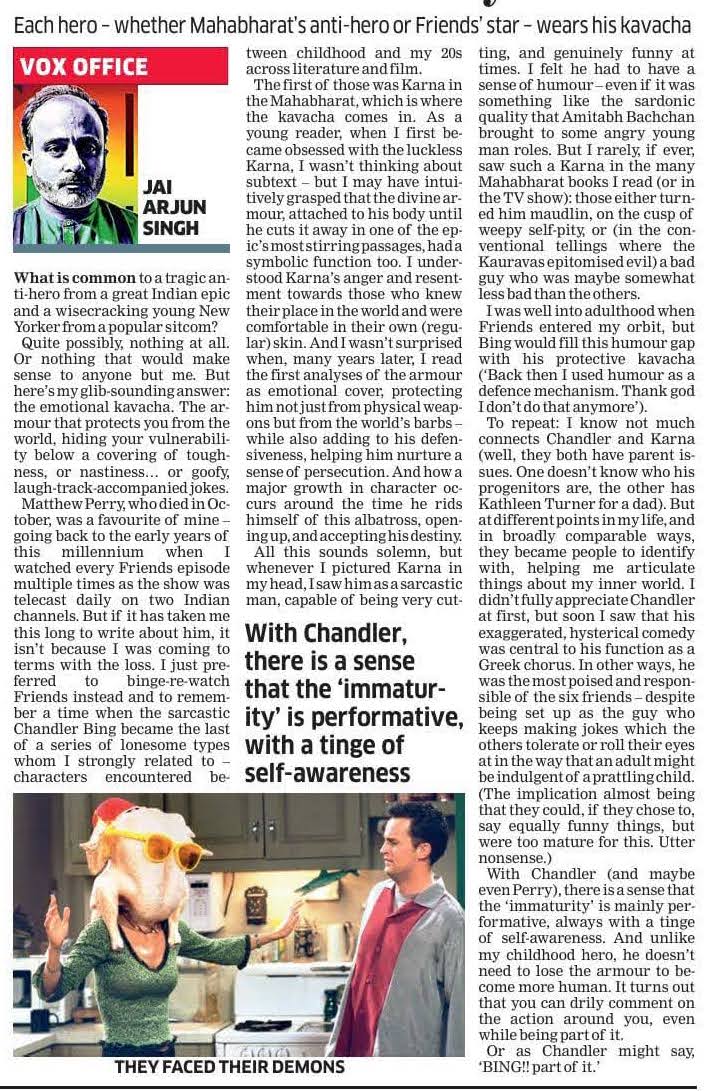 To repeat: I know not much connects Chandler and Karna (well, they both have parent issues. One doesn’t know who his progenitors are, the other has Kathleen Turner for a dad). But at different points in my life, and in broadly comparable ways, they became people to identify with, helping me articulate things about my inner world and my ways of dealing with the terrifying outside world. I didn’t fully appreciate Chandler at first: when I had only watched snippets of Friends on TV before I began watching the show properly, he came across as the least personable, the loudest, the most dependent on what one sometimes sees as facile, broad comedy. But soon I saw that his exaggerated, hysterical comedy was central to his function as a Greek chorus. In some other ways, he was the most poised and responsible of the six friends – despite being set up from the start as the guy who keeps making jokes which the others tolerate or roll their eyes at in the way that an adult might be indulgent of a prattling child. (The implication almost being that they could, if they chose to, say equally funny things, but were too mature for this. Utter nonsense.)
Over the course of a 236-episode situation comedy, it is inevitable that we will see each of these six protagonists at their silliest, most immature, most vulnerable at some point or the other – and that character arcs won’t be consistent over 10 years, they will be subordinate to the creation of funny “situations”. But with Chandler (and maybe even Perry), there is a sense that the immaturity is mainly performative, always with a tinge of self-awareness. And unlike my childhood hero, he doesn’t need to lose the armour to become more human. You can drily comment on the action around you, even while being part of it.
Or as Chandler might say, “BING!! part of it.”
(Related posts: Friends and masala; Karna in Mrityunjay)
Saturday, January 13, 2024
In praise of Destry Rides Again

Here is an example of a studio-era film where all the constituent parts come together brilliantly, under the direction of someone (George Marshall) who doesn’t have a reputation as an auteur or a “personal filmmaker”. One tends to associate such films with reliable solidity (Casablanca might be a major example), as opposed to zaniness, but Destry Rides Again is very much the latter. While it isn’t a revisionist Western in the sense that some films from the 1950s and 1960s onward were, it is offbeat and free-flowing (in comparison, John Ford’s Stagecoach, made the same year, seems traditional and hemmed-in) – a sort of masala movie with bawdy comedy and serious drama (there are a couple of very moving scenes, and beautifully shot close-ups) and music and madness, and even a touch of police procedural.
 You haven’t experienced Wild West whimsy until you’ve heard Jimmy Stewart (with his fiercest expression and fastest drawl) say the line: “Now the next time you fellas start any of this here promiscuous shooting around the streets, you’re going to land in jail. Understand?” Or when Mischa Auer (one of many super character actors in this film) unnecessarily says: “Yes Mon Commandant. I am a courier, fast as a bolt of lightning, silent as the night itself” before heading off to perform an important errand for Destry. You can completely see why Mel Brooks was influenced by this film when making Blazing Saddles.
  In my view, this film also played as big a part in the creation of the Stewart screen persona as the much better known Mr Smith Goes to Washington did the same year. Meanwhile, Dietrich had been a big star for years, but was being labelled “box-office poison” at this time, and this is one of her most fun roles: yee-haw-ing away in her opening scene in a rambunctious saloon, cat-fighting, singing. (That same year, 1939, Ninotchka was famously promoted as a film where Greta Garbo laughed – and a remote and icy screen goddess was humanised – but Destry Rides Again also gives us a more accessible Marlene Dietrich, compared to the parts she did for Josef von Sternberg earlier in the decade.)
So much fun, especially if you’re interested in the history of the Western and the many avatars it took before it settled into the self-consciously revisionist version of the late 1960s and beyond. I try to avoid making recommendations, since I don’t presume to know anyone else’s tastes, but do give this a try. The first 15 minutes or so is chaos, but it settles into a proper storyline after Destry arrives. For those who haven’t watched much from 1930s Hollywood, this is also a useful introduction to performers like Brian Donlevy (who played the lead in Preston Sturges’s wonderful The Great McGinty), Una Merkel, Charles Winninger, and of course Mischa Auer.
I have shared a good print of Destry Rides Again on my film group. If anyone here wants it, let me know.